Data Storytelling 2.0: How AI Creates Perspectives – And Demands Responsibility
Data is everywhere. In reports, dashboards, presentations, analyses. It documents, compares, measures, forecasts. And yet it happens time and time again: the figures are impressive – but the message doesn’t get across.
The Real Problem isn’t the Data
Companies invest enormous resources in data collection, dashboards, and KPI systems. Knowledge is more readily available than ever before. But more information does not automatically lead to greater clarity.
“The problem is rarely the data itself. The problem is that it doesn’t tell a story.”
says Nora Feist, storytelling expert and managing director of Mashup Communications
Data Alone Rarely Convinces
Studies show that data alone is often not enough to really convince people. When numbers are embedded in a story, we understand them better – and remember them longer.
In studies, so-called “data stories” performed significantly better than traditional diagrams or dry reports. Participants were able to grasp information more quickly and classify it more clearly. This explains why reports without storytelling often remain ineffective.
Data Storytelling: Meaning Instead of Data Overload
This is precisely where data storytelling comes in. It’s not just about making charts more attractive or adding emotion to numbers. It’s about bringing structure to complexity. Creating a common thread. Using data to form a comprehensible narrative.
How Does AI Help With Data Storytelling?
The use of artificial intelligence is fundamentally changing this work.
AI can:
- Detect patterns in large amounts of data
- Make trends visible
- Suggest connections
- Identify outliers
- Develop alternative storylines
At first glance, this sounds like an efficiency gain. But this is where the real challenge lies. Because AI interprets.
When sales and employee satisfaction rise in parallel, she quickly formulates a causality. When growth is strong, she talks about market leadership. When a major customer accounts for 35 percent of sales, she can turn this into a risk or a strength – depending on how she frames it.
The data remains the same. But the story changes.
Same Data, Different Stories.
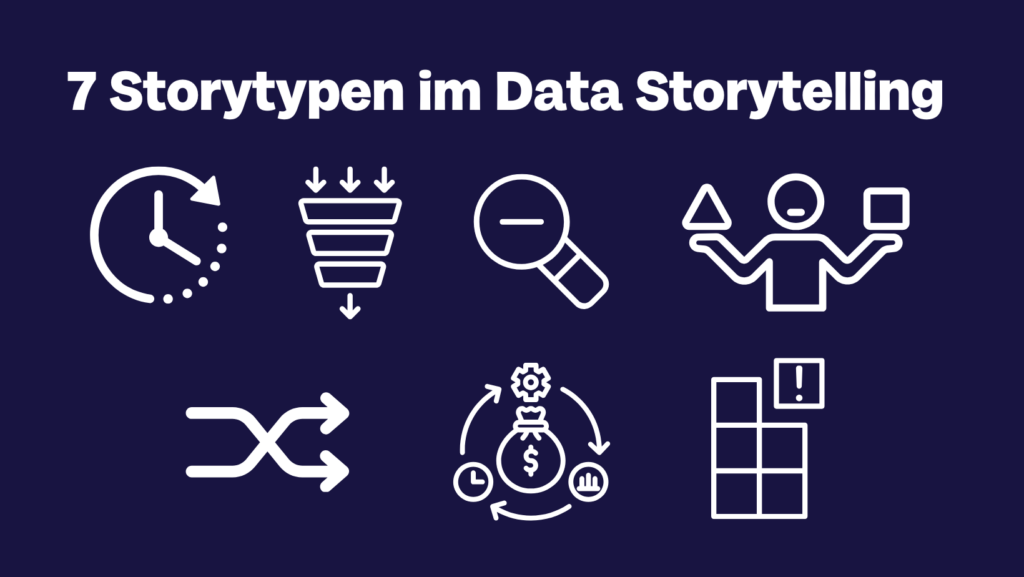
It becomes particularly exciting when you deliberately look at data through the different story plots:
- Change Over Time: How is something evolving?
- Drill Down: What’s behind the total number?
- Zoom Out: What does the big picture look like?
- Contrast: Who or what is in opposition?
- Intersections: Where do two developments converge – and what does their interaction mean?
- Factors: Which influencing factors or drivers truly explain the result?
- Outlier: What does not fit into the pattern?
AI allows these perspectives to be quickly played out. But each perspective changes the meaning of the facts.
A growth chart can become a success story. Or – in the “outlier” plot – a risk story, if 35 percent of sales depend on just one major customer.
The numbers are the same. The interpretation is not.
Who Controls Interpretation?
At a time when AI automates analyses and generates reports at the touch of a button, one skill is becoming increasingly important: conscious storytelling.
Data storytelling with AI does not mean relinquishing responsibility. On the contrary, it means using AI as a sparring partner – while remaining critical.
Data provides raw material. AI provides perspectives. Meaning arises through selection.
And it is precisely this selection that determines whether the figures merely inform – or truly convince.
More Articles on Data Storytelling
- 5 reasons for data storytelling: How can we bring facts and figures to life?
- Data Storytelling in Video Form: How Numbers in Motion Become an Experience
More Knowledge About Data Storytelling

Nora Feist ist Storytelling-Enthusiastin, PR-Expertin und gemeinsam mit Miriam Schwellnus Geschäftsführerin von Mashup Communications. Seit 2010 begleitet sie Unternehmen dabei, ihre Geschichten zu entdecken und zu erzählen. In Workshops, Webinaren und Online-Kursen gibt sie gern ihr Wissen rund um Storytelling und Employer Branding weiter.
Share this article
Related articles


27 August 2026