10 Years of Instagram Stories: From the Perfect Feed to the 24-Hour Story
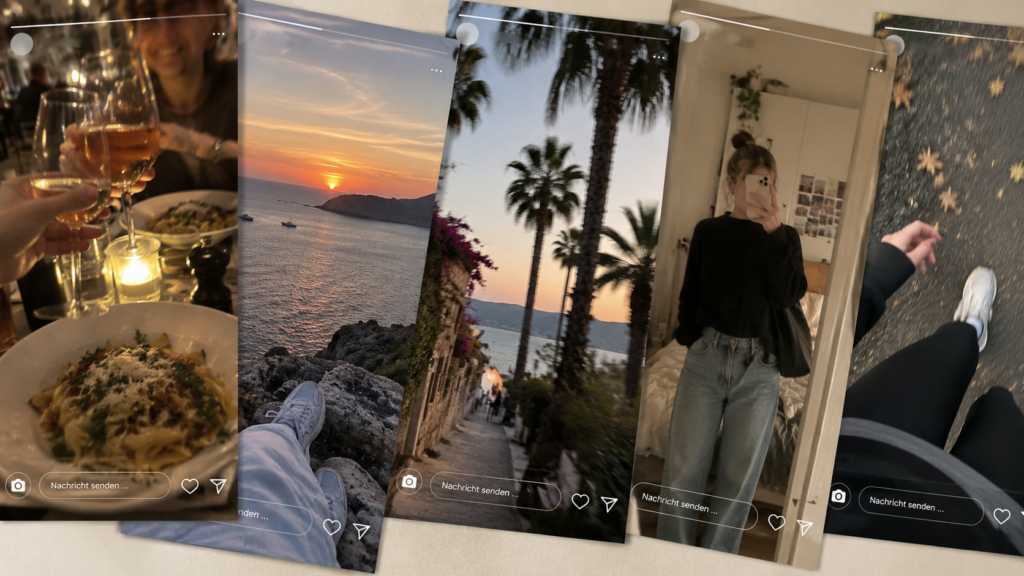
There was a time when I used to plan my Instagram feed down to the last colour and order. Some pictures remained as drafts, whilst others were later moved back into the archive. And then, of all things, there came a phase when the feed was meant to look as chaotic as possible. Ideally, of course, just chaotic enough that it ended up looking rather good after all.
A bit of that mental imagery has stuck with me. These days, I can spend so long selecting, sorting and re-viewing a feed post that the moment is almost over before I’ve finished.
A story? That almost always works.
Perhaps that is the best explanation of how Instagram Stories have changed things over the past ten years.
On 2 August 2016, the small circles appeared at the top of the screen for the first time. Photos and videos remained visible for 24 hours and then disappeared. Instagram co-founder Kevin Systrom aptly described the feed at the time of its launch: ‘Instagram is a curated feed, but you only get to see the highlights. Even his most recent post at that point was already six days old, because the moments in between seemed too mundane to him.
Stories gave these moments a place.

When Suddenly Not Everything Had to Be a Feed Anymore
Snapchat had long since pioneered the idea. Systrom spoke very openly about it at the launch and explicitly gave credit to the competitor for it. Instagram took the concept and applied it to a network that, until then, had been heavily characterised by the perfect single image.
It sounds trivial today, but back then it made a big difference: that shaky concert video was suddenly allowed to sit alongside the carefully selected holiday snap. Morning coffee didn’t need a permanent place on my profile, any more than a meal in a restaurant or just any old moment on the way home. In my case, there were quite a few photos of meals and blurry snapshots from nights out. Things where you knew even as you were uploading them: nice for today, but please not on my profile for the next five years.
This also opened up new possibilities for brands. The feed continued to feature campaign visuals, products and carefully crafted images. Suddenly, Stories could showcase the ‘before’ and ‘after’: the set-up before an event, a glimpse into the office or a spontaneous reaction to something happening in the moment.
Yet a story was never automatically more authentic. You can film a seemingly spontaneous mobile video just as many times as you can take a photo for your feed. What has changed is more a matter of expectations: a smartphone video no longer had to look like an advert.
The Thumb Becomes Part of the Story
But there was something else that made storytelling even more exciting: suddenly, a story no longer had to fit into a single image. A wide shot to start with, a close-up on the next slide, then a video, and three taps later the resolution – it was now the thumb that set the pace, not the caption.
For brands, this meant that a product could be revealed bit by bit, and an event could be turned into a mini live report. Polls, quizzes, emoji sliders and, later on, questions or links turned simply watching into a small-scale interactive experience. My article ‘More than just 😭 and ❤️’ also shows how even an emoji can become part of the story.
Nike demonstrated just how far this interaction could be taken in a particularly compelling way on Air Max Day 2018. For individual trainers, they created their own little story worlds complete with hidden elements and choices. The way the story was navigated became part of the concept itself – users didn’t simply click through images; they moved the story forward with their thumb.
Examples like these show that a story works best when the idea is designed for that space right from the start. Success was quickly followed by professionalisation.
And at Some Point, Even Spontaneity Ended Up with an Editorial Plan
Just a few months after its launch, adverts began appearing in Stories. Businesses quickly realised how attractive this new space was. By its first anniversary in August 2017, 250 million people were already using the feature every day.
What started as a casual glimpse behind the scenes gave way to templates, editorial plans and KPIs. Ironically, it was the unplanned that became predictable. The principle is probably not entirely unfamiliar: at first, everything was supposed to look perfect; later, the seemingly casual ‘photo dump’ became the new ideal. Even chaos, it seems, can withstand a great deal of planning.
‘Finstas’ – secondary accounts for a closer circle of friends – are a good example of how quickly smaller spaces began to form alongside the more professionalised ‘Story’. The name stands for ‘fake Instagram’, although many young people described these very accounts as the more honest version of their Instagram lives. A study in the Journal of Computer-Mediated Communication shows that teenagers posted more spontaneously and personally on these accounts, and also shared more complex emotions. On their main public account, the impact their posts had on others played a greater role.
At the end of 2018, Instagram introduced Close Friends, turning this need into a built-in feature of the app. I still notice this myself to this day. My account is public, but private matters end up in the green circle. This little green ring has almost become a sort of living room, whilst the front door remains wide open to the outside world.
For brands, there is an underlying concept that has hardly changed over the years:
‘A planned story can come across as very relatable. The key question is whether the channel has a genuine purpose: am I showing something here that would otherwise get lost in the feed? Am I letting people get a closer look? Or am I simply turning the same campaign image into a portrait format? For me, good storytelling begins when the content is genuinely intended for this space.’
Katrin Lenz, PR & Brand Storytelling Consultant at Mashup Communications
That was by no means the end of the desire for less theatrics.
How Often Can Social Media Reinvent Reality?
In 2022, BeReal seemed, for a moment, to have found the next answer to this question. The prompt appeared once a day. Two minutes’ time. Front and rear cameras. As little preparation as possible.
For anyone who felt Instagram had become too polished again, this almost felt like a minor counter-trend. Of course, it wasn’t long before Instagram itself tested a similar idea with Candid Stories.
The hype surrounding BeReal also died down later on. According to Appfigures, global downloads fell by around 60 per cent between 2023 and 2024. The story could hardly be more fitting: as soon as ‘unfiltered’ becomes a promise in itself, even the unfiltered eventually develops its own aesthetic.
From the Perfect Feed to the Green Circle And On to the Chat
Perhaps I myself belong to the generation in which this change can be observed particularly clearly. Born in 1999, I grew up with the ‘perfect feed’, still use Stories all the time, and am more of a viewer than a creator when it comes to Reels. These days, I can spend so long selecting and then discarding a feed post that I end up not uploading anything at all. A Story goes online much faster. And there are some things I now send directly to specific people without even thinking about posting them publicly.
Instagram head Adam Mosseri now describes this shift as applying to the platform as a whole: more photos and videos are shared via Direct Messages each day than via Stories, and more via Stories than via the feed. In May 2026, another feature was introduced: Instants – unedited photos shared directly with Close Friends or mutual followers, which then disappear again.
Ten years after the launch of Stories, Instagram has, surprisingly, come quite close to the original idea once again: share the moment before you overthink it.
What Remains After 24 Hours
The feed is a bit like a shop window, the Story is like a glimpse through an open office door, and the DM is the conversation that follows – even if the boundaries between them are constantly blurring. Instagram itself revamped its brand identity in August this year, after more than ten years.
Meta cited, amongst other things, the fact that the way the platform is used has changed fundamentally during this time. The old Instagram has never completely disappeared: beautiful feeds, campaign images and perfectly produced Reels are still very much part of it. It’s just that, these days, not every moment has to fit into the same mold.
The biggest difference compared to my Instagram from back then is probably this: the feed is still there, but it’s no longer where everything goes. Some things only belong in the Story for a day, some only in the green circle, whilst others end up straight in the chat. And, of course, some pictures still sit in my drafts for far too long.
In 2016, Kevin Systrom spoke of a feed full of highlights. Ten years on, the highlights are still there. We just have a lot more space for everything in between.
FAQ: 10 Years of Instagram Stories
What role will Instagram Stories play for brands in 2026?
Stories are particularly well suited for providing up-to-date insights, behind-the-scenes content, interaction and engagement with an existing community. Compared to the public feed, they feel more intimate and immediate.
What is the difference between Instagram Stories and Instants?
Stories can be created, edited and shared with all your followers or with Close Friends. Instants focus more on the here and now: the photo is taken straight away and shared unedited with a smaller group of people.
Why do Instagram Stories disappear after 24 hours?
The time limit was part of the concept from the very beginning. It makes room for everyday and spontaneous moments that don’t need a permanent place on the profile.
How do the Feed and Stories differ these days?
The feed is more permanent and has a wider public reach. Stories are better suited to current, ongoing and interactive content within the existing community. Close Friends and Direct Messages create further levels for more personal interaction.

Mit einem Studium in Literatur-, Kunst- und Medienwissenschaft sowie Kultur- und Medienmanagement verbindet Katrin Lenz künstlerische Perspektiven mit strategischer Kommunikation.
Share this article
Related articles



25 September 2026
The Art of Micro-(Content) Storytelling. Or: How Much Story Can Fit into 3 Seconds?
Read More