
Strong Employers, Weak Stories: The Employer Branding Problem Facing Global Market Leaders
Germany is the world champion of staying under the radar. Hundreds of companies lead global niche markets without the general public or many college graduates even knowing their names. They produce ultrasonic cleaners, specialty adhesives, semiconductor components, and precision valves. Their products are world-class. As employers, however, many of them remain largely invisible.
Why do many German global market leaders in employer branding sell themselves short?
Many German global market leaders have a strong employer culture, but they rarely communicate it on their career pages. Our systematic analysis of more than 450 German global market leaders shows that, for 45 percent of them, the reality of being an employer does not match their public image. Twenty-four percent are what we call “undersellers”: They receive above-average ratings from employees but rarely highlight their strengths in their recruiting efforts.
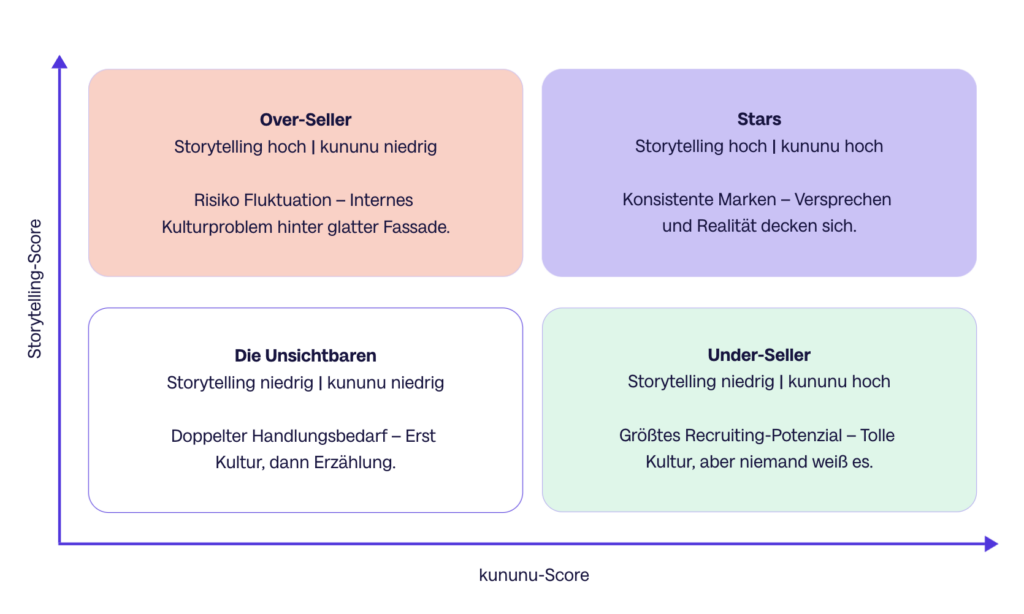
For 45 percent of companies, there is a gap between perception and reality
This highlights two contrasting employer branding challenges:
- 24 percent are “under-sellers”—good employers with poor communication skills.
- 21 percent are “over-sellers”—companies with strong employer branding, but whose employee ratings are significantly lower.
The “Under-Sellers”: 24 Percent Are Giving Away Their Greatest Recruitment Asset
The most surprising group in our analysis is the “under-sellers.” About 24 percent of the global market leaders we examined have kununu ratings of more than 3.8 stars, placing them above average as employers. At the same time, they achieve a storytelling score of less than 7.5 out of 10 points.
Their career pages often read like fact sheets: accurate, comprehensive, but indistinguishable from one another. These companies don’t necessarily lose out in the competition for talent because of a weak employer culture. They lose out because their strengths are barely visible to potential applicants.

One reason for this often lies in the corporate culture itself: In many medium-sized industrial companies, modesty is considered a virtue. People don’t talk about themselves; they deliver results. In sales, this principle often works well. There, products, client references, and export figures speak for themselves. In recruiting, however, this is increasingly no longer enough.
Younger job seekers, in particular, pay close attention to whether an employer clearly communicates its values, culture, and social impact. According to the Deloitte 2026 Gen Z and Millennial Survey, 67 percent of Generation Z respondents would turn down a job if the company did not align with their personal values.
“This is where one of the greatest untapped recruitment opportunities lies in Germany’s small and medium-sized enterprises. An excellent corporate culture that skilled workers know nothing about remains virtually invisible in the competition for talent.”
Nora Feist, managing director of Mashup Communications, a Berlin-based PR and brand storytelling agency that conducted the analysis
“Over-sellers”: 21 percent promise more than they can deliver
A second group presents the opposite picture. The career pages talk about “New Work,” development opportunities, working as equals, and modern leadership. However, employee reviews paint a much more critical picture.
About 21 percent of the companies analyzed score highly in storytelling but perform significantly worse in employer ratings. This poses a particular risk: Strong employer messaging specifically attracts people who are looking for exactly the culture that’s promised. If these expectations aren’t met in day-to-day work, disappointment sets in—with potential consequences for employee retention, turnover, and recruiting costs.
“Over-sellers focus on optimizing their career page, while the real problem lies deeper. If a company doesn’t deliver internally what it promises externally, it can’t bridge that gap permanently—even with a large storytelling budget.”
Nora Feist, Managing Director and Head of Employer Branding at Mashup Communications
For these companies, successful employer branding therefore does not begin with a new campaign. First, they must determine whether their actual work environment lives up to their promises.
The Stars and the Invisible: A Comparison of Two More Groups
In addition to “under-sellers” and “over-sellers”, the analysis identifies two other groups. About 26 percent of the companies surveyed achieve top scores both in terms of their internal perception as an employer and their external communication. They demonstrate that a consistent employer brand is possible regardless of company size and name recognition.
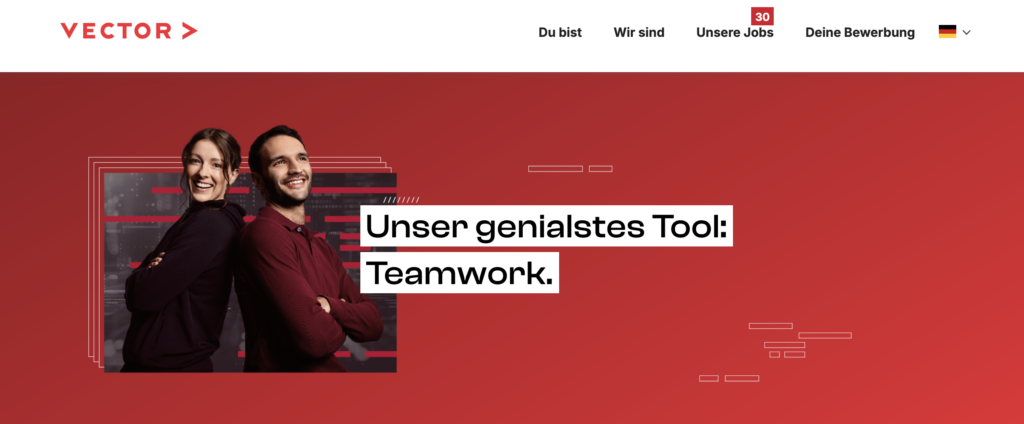
In our analysis, for example, Siemens achieved a storytelling score of 9.4, Adidas 10.0, and Vector Informatik 9.7. Vector Informatik, in particular, demonstrates that compelling employer branding is not the exclusive domain of large corporations: this medium-sized software provider achieves scores in its employer communications on par with those of large, internationally renowned brands.
The remaining approximately 29 percent score below average on both dimensions. This group can be described as “the invisible ones”: often B2B companies whose employer profile is not readily apparent to the outside world and which, at the same time, do not generate a strong counterbalance in employee evaluations.
Better communication alone is not enough here. Before a compelling employer story can be developed, companies must assess the actual strengths and areas for improvement that shape their employer culture.
What Companies Can Learn from This for Their Employer Branding
- Under-Sellers: Highlight existing employer strengths.
- Over-Sellers: First, align the reality of the workplace with the employer’s promises.
- The Invisible Ones: Collaboratively develop the employer profile and the actual company culture.
The shortage of skilled workers in Germany is often described as an external problem: demographic change, a lack of talent, and international competition for qualified professionals. Yet part of the challenge lies within the companies themselves. Career pages remain too functional. Employers’ strengths are not highlighted. Or promises are made that do not match the actual reality of the workplace.
This is precisely the key finding of our analysis: 45 percent of the global market leaders we examined do not have a single employer branding problem, but rather two completely different ones. For “under-sellers,” the challenge is to communicate their existing strengths in a way that is both visible and relevant. For “over-sellers,” the internal reality must first align with the external promise.
“Successful employer branding starts with getting the order right. Some need to do a better job of communicating what’s already there. Others need to first make sure their story is actually true.”
Nora Feist, storytelling expert in employer branding at Mashup Communications
FAQ: Employer Branding in Small and Medium-Sized Businesses
What Makes for Effective Employer Branding in Small and Medium-Sized Businesses?
Effective employer branding in small and medium-sized businesses highlights a company’s true strengths and culture. It is crucial not only to articulate values, corporate culture, and day-to-day work, but also to convey them credibly through concrete stories and insights.
What is an “under-seller” in employer branding?
In our analysis, we use the term “under-seller” to describe companies that receive above-average ratings from their employees but fail to adequately convey their strengths as employers on their career pages.
What is an “over-seller” in employer branding?
“Over-sellers” effectively communicate their employer brand to the outside world, but receive significantly lower ratings from their employees. This creates a gap between the employer’s promises and the reality employees experience.
Why isn’t a good careers page enough on its own?
A compelling careers page can attract attention and spark interest among talented individuals. However, it will only be effective in the long run if the values and promises conveyed on the page align with the actual reality of the workplace.
More Articles on Small and Medium-Sized Businesses

Nora Feist ist Storytelling-Enthusiastin, PR-Expertin und gemeinsam mit Miriam Schwellnus Geschäftsführerin von Mashup Communications. Seit 2010 begleitet sie Unternehmen dabei, ihre Geschichten zu entdecken und zu erzählen. In Workshops, Webinaren und Online-Kursen gibt sie gern ihr Wissen rund um Storytelling und Employer Branding weiter.
Share this article
Related articles

10 November 2026
Strong Employers, Weak Stories: The Employer Branding Problem Facing Global Market Leaders
Read More

27 October 2026
The Business of Outrage: Why Brands Deliberately Push Our Buttons with Ragebait
Read More

13 October 2026