It’s a match: This is why PR agencies should not neglect storytelling
Nothing but hot air? In the marketing universe, we are confronted with the buzzword storytelling from all directions. But what is it all about and how can PR agencies utilise this technique as a tool for themselves?
A particularly telling example of just how powerful storytelling can be is the following line by Ernest Hemingway, which I first read in the book „Erzählende Affen“ : “For sale: baby shoes, never worn.” Just six words are enough to set the imagination in motion… For PR consultants, who deal with language on a daily basis, it therefore makes even more sense to link storytelling to a brand and use it to their advantage.
What is storytelling in PR?
Storytelling in PR involves conveying corporate messages, products, or topics using narrative structures. Rather than communicating information solely through facts, the focus is on people, challenges, conflicts, and solutions. The goal is to make complex messages easier to understand, more emotionally engaging, and more memorable.
“Once upon a time…” – Why does Storytelling Work in PR?
Stories capture attention, make complex messages easier to understand, and can create emotional connections. That’s exactly why storytelling is so well-suited to PR: it provides context for information and makes abstract corporate messages tangible by drawing on real people, challenges, and developments.
We’ve seen it in movies and commercials, religious tales, and fairy tales—storytelling is the perfect way to evoke emotions. But why is that? The book „Storytelling für Unternehmen“ by our founder, Miriam, provides the answer: The human brain is always searching for explanations and experiences, which is why it automatically responds to stories.
When it comes to good stories, our brains don’t just sit back and watch: when we observe the actions and emotions of others, some of the same neural networks are activated as when we experience those things ourselves. Researchers link this effect, among other things, to the mirror neuron system and our capacity for empathy. (Source)
Storytelling therefore makes it possible to create an emotional connection between the audience, the person telling the story and the story being told – the perfect requirement for using this tool in corporate communications. After all, there is no PR without a storyline.
Heroes and Mentors: How Storytelling Works in PR in 4 Steps
1. Identify the target audience: Who should the story be relevant to?
2. Define the hero: Is the focus on the company or the target audience?
3. Identify the conflict: What challenge needs to be overcome?
4. Define the brand’s role: Is it the hero, or does it serve as a mentor?
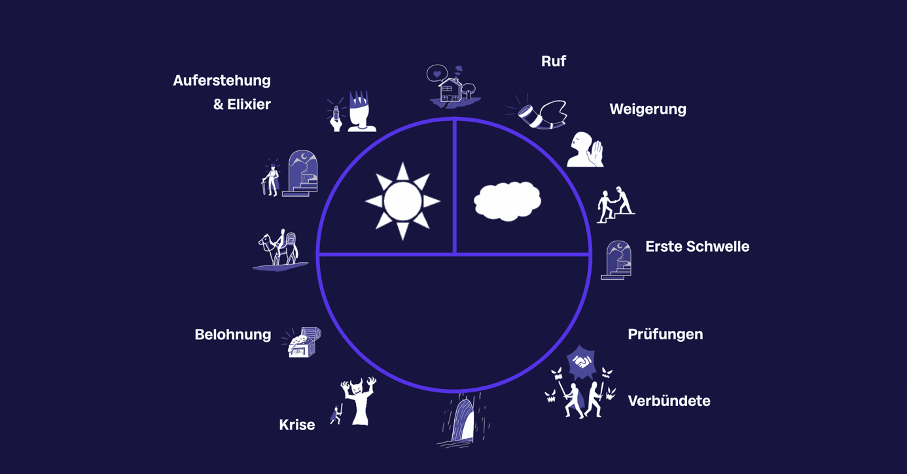
Storytelling creates a point of connection for the target audience, fostering trust in a company or product. To find suitable stories, it’s worth applying the principle of the hero’s journey to the history of the company or its potential customers. This concept originates from Joseph Campbell, who identified a common thread while analyzing myths, legends, and narratives. A mentor plays a key role in this process. The hero or heroine—who must overcome trials and crises on a journey—can be either a company or its customers.
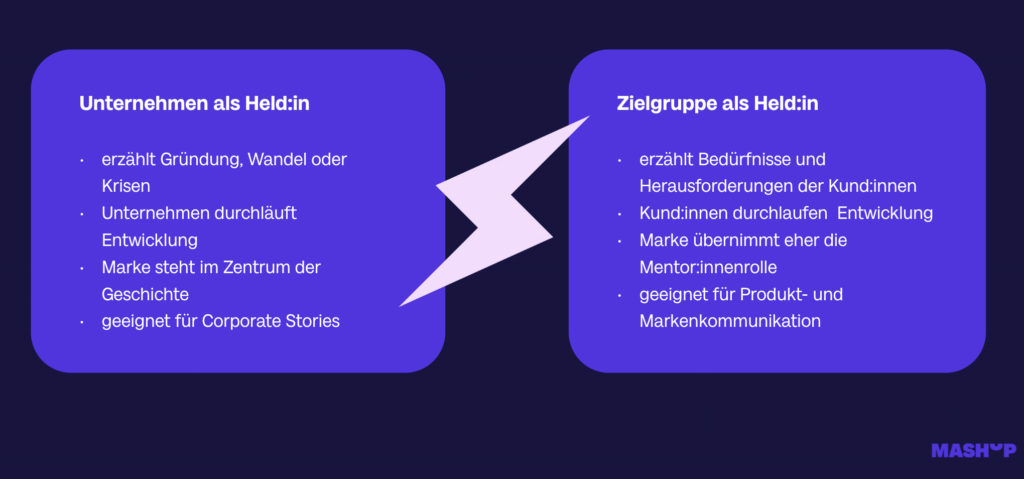
The company as hero
Every hero’s journey begins in the familiar world or in a specific industry. The founders have recognised the need for a new product or service (the call), but are confronted with self-doubt or difficult starting conditions in the first step (refusal). This is where the mentor comes into play, providing the necessary support and guidance. This can be an outstanding person or an internal team.
Once the first obstacle has been successfully overcome, the hero or heroine must face trials, find allies and fend off enemies. Once the final, all-important crisis has been overcome, a reward awaits our hero. Now they can return to the familiar world, enriched by many experiences (elixir).
In our PR strategy, we encourage companies not only to highlight the positive aspects of the hero’s journey in their communications but also to address crises. Various story plots such as “From dishwasher to millionaire” or “Rebirth” are perfect for this. Let’s turn the tables and take a look at the hero’s journey of the target group:

The target group as hero
Beauty, simplicity or wholeness? We all have a need for self-realisation. If a company shares the same values as we do, it can act as a mentor and support us on our hero’s journey with its product or service. Looking for employees? The same principle also works in employer branding.
Who should play the role of the hero in PR stories?
What mistakes should companies avoid when using storytelling in PR?
The three most common mistakes in PR storytelling:
– Stories fail to address the needs of the target audience.
– Narratives come across as contrived or overly dramatic.
– Storytelling is conceived exclusively as text.
1. Forgetting the target group: It is a no-go to lose sight of the needs and interests of potential customers. Storytelling in PR should always aim to reach the “right” people and encourage them to take action. If the story told is not relevant or appealing to the target audience, this can lead to the message being lost and the PR activity remaining ineffective.
2. Fake stories: At Mashup Communications, we firmly advise our clients against inventing or over-dramatising narratives to attract attention. This is because if stories are perceived as manipulative or untrustworthy, this can undermine the trust of the target group and even damage the brand’s reputation in the long term.
3. Boring wastelands of words: Storytelling is not only applicable in text form. Photos, graphics or video material should also be integrated into press releases to capture the attention of readers. Doodles from Google or Pinterest are good examples of visual storytelling.
Storytelling in PR: Best Cases
Now that I have listed all the “don’ts”, the “dos” should of course not be missing. An example of how powerful storytelling can be in a PR campaign comes from GoPro with the fitting title “Be a Hero”.
In this campaign, GoPro puts its customers centre stage by sharing their adventures and experiences with the world. GoPro users are presented as heroes who use their cameras to capture breathtaking footage of their activities – be it surfing, skiing, climbing or other adventures. GoPro acts as a mentor in this campaign, providing its customers with the tools and technology to document and share their own hero’s journeys. By using GoPro cameras, they can capture their adventures and see themselves as the heroes of their own stories.
What can companies learn from this?
Successful PR storytelling doesn’t necessarily have to make the brand the hero. If a company instead focuses on its target audience and the challenges they face, the brand can take on the role of a mentor who provides the solution or support.

The bottom line: Dream big!
Storytelling has become essential in PR work because it enables connections to be made, emotions to be aroused and messages to be conveyed authentically. When companies – like GoPro – focus on their target group and help them to achieve their goals, this is the best way to tell a success story. If the dos and don’ts of storytelling are considered, stories can be heard, understood and appreciated – and thus leave a lasting impression.
From trust to brand awareness: Find out here what PR can—and cannot—achieve beyond that.
TL;DR: Storytelling in PR
- 📖 Storytelling translates corporate messages into understandable stories
🎯 The starting point is always the needs and interests of the target audience
🦸 Either the company or the target audience can take on the role of the hero
🧭 If the target audience becomes the heroine, the brand can act as a mentor
⚡ Conflicts, challenges, and crises make stories interesting
❤️ Authenticity is more important than artificial dramatization
📸 Storytelling works not only through text but also visually
💡 Good PR stories combine information, emotion, and relevance

Das Redaktionsteam von Mashup Communications, der Berliner Agentur für PR und Brand Storytelling (gegründet 2009), besteht aus erfahrenen Expert:innen zu den Themen PR, Content Marketing, Employer Branding, KI und Storytelling.
Share this article
Related articles


25 September 2026
The Art of Micro-(Content) Storytelling. Or: How Much Story Can Fit into 3 Seconds?
Read More