Our AI Principles, Part 5: AI Facilitates Collaboration, not Responsibility
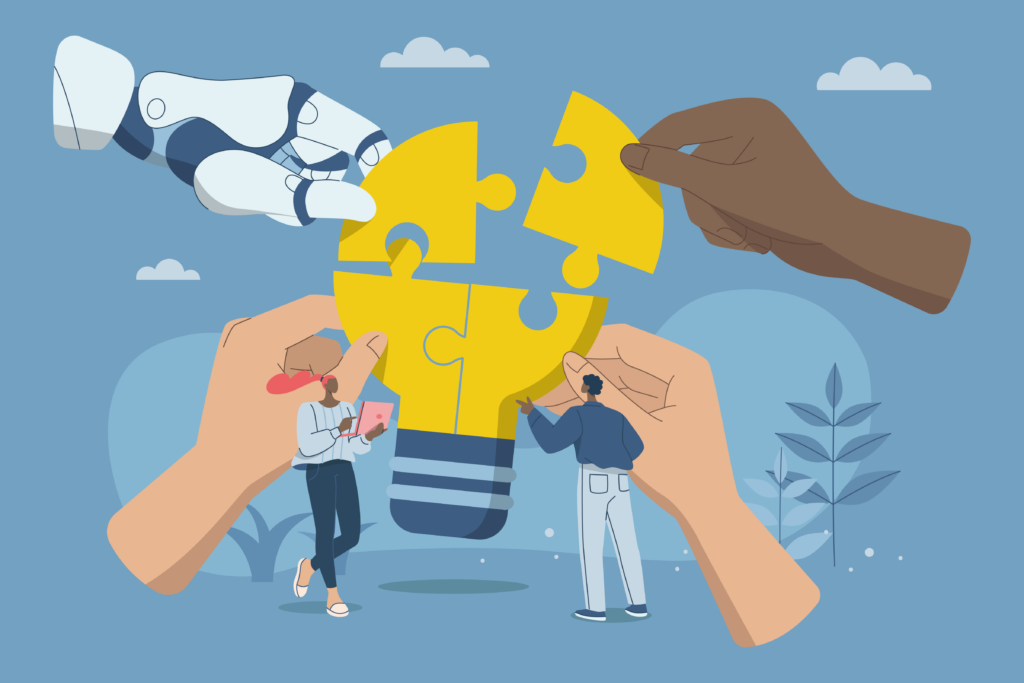
Sometimes it’s just one sentence in a client briefing that changes everything. A half-sentence, said almost casually, that reveals a concern, a goal, or a hidden story between the lines. If you listen closely, you’ll recognize that moment when communication is more than just content.
Artificial intelligence is of no help in such situations. What is needed here is tact.
And that is precisely why “tact” is one of our core AI principles. Because despite all the ways AI makes our lives easier, it can never replace our intuition.
Communication is more than Automation
We deliberately use AI to simplify processes: in briefings, research, the editorial preparation of complex content, and the documentation of meetings. This saves time, speeds things up, and ensures that we can focus on what’s important: the interpersonal level of collaboration.
Anyone who works with people – clients, journalists, partners – knows that every interaction is unique. Every exchange is a small social network. Artificial intelligence doesn’t draw conclusions when someone’s voice gets quieter during a conversation. It doesn’t recognize subtext. We do.
What We Do – And What We Don’t Do (Yet)
AI supports many of our internal processes – especially those involving structure, efficiency, and initial impulses. For example:
- in the preparation and consolidation of briefings
- in research work and data analysis
- when documenting meetings
- in editing and structuring initial drafts
- and in strategic preliminary considerations, such as positioning
AI-generated content, where authenticity and empathy are paramount – for example, in consulting services, crisis communication, or direct interaction with journalists – is not part of our repertoire.
We are also deliberately avoiding fully automated touchpoints with stakeholders, such as AI-supported avatars. We tell real stories about real people.

Where Machines Help – and Where Humans Lead
In one of our recent projects, AI guided an employee through a complex data analysis tool. The prompt was precise and the result helpful. But the key insight came from her: “I guide the AI so that it can guide me.”
In other cases, it’s the other way around: we give AI tasks that don’t require sensitivity, such as summarizing a 30-page input document or evaluating a survey. But always with the clear understanding that we are the ones setting the pace.
Our AI Principles: Collaboration is Responsibility
What makes good cooperation for us? Openness. Honesty. Trust on equal terms. And the awareness that communication is not a one-way street.
AI can support, but it cannot connect. Especially in sensitive contexts – such as crisis scenarios or personal consulting – we rely on our intuition, our team spirit, and our experience. When it comes to nuances, nothing can replace human empathy.
We believe in the potential that AI can create for us. We may not yet have a project in which it has measurably freed up more time for creative excellence. But we know that this space will emerge when we combine technology with attitude.

Miriam Schwellnus ist Expertin für Public Relations, Brand Storytelling und Employer Branding im KI-Zeitalter. Als Geschäftsführerin der Berliner PR-Agentur Mashup Communications (gegründet 2009) manövriert sie bekannte wie auch neue Gewässer in der Medienwelt mit Begeisterung.
Share this article
Related articles


27 August 2026