
From The Island To The Museum: The Best Storytelling Campaigns In January 2026
January is rarely the month for grand gestures. It’s more about the little things that stick: a phrase you recognize immediately, an image that triggers a feeling, a moment that says more than it explains. That’s where good storytelling comes into its own. Four campaigns from January 2026 that show how much impact everyday life can have.
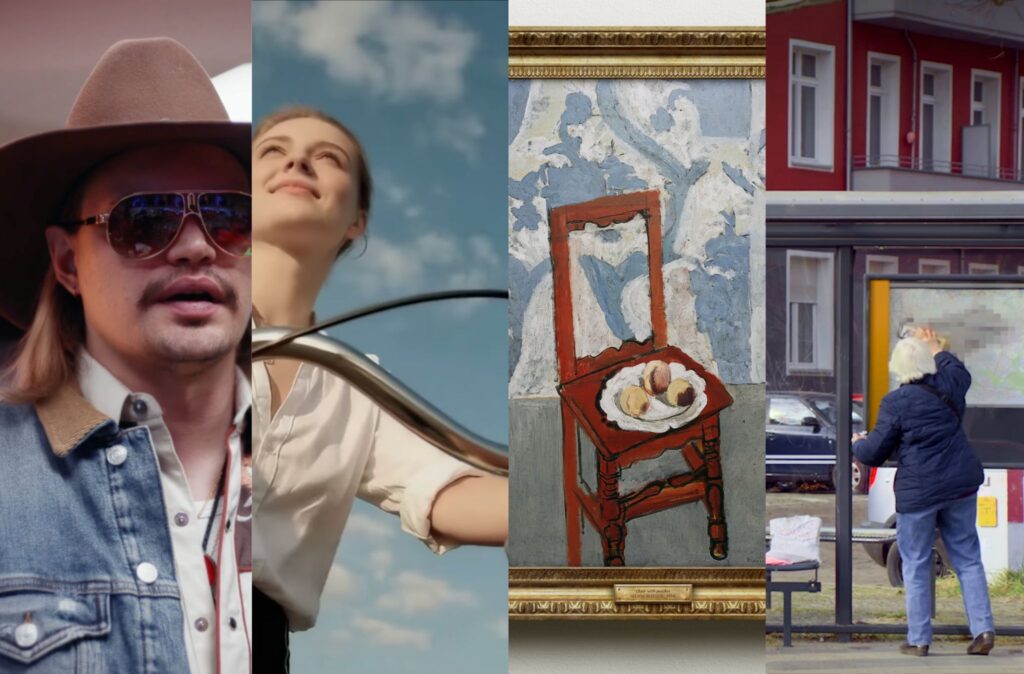
Rügenwalder Mühle – “Reiter-Spot Reloaded”: A Cult Phrase, Completely Translated Into The Present Day
One word is enough to immediately bring you back. “ALLE!” (ALL!) is one of those advertising slogans that sticks in your head before you even have time to think. Rügenwalder is bringing back the rider commercial, but not as a retro piece, rather as a clear remake: an e-bike instead of a horse, a pub instead of a field, a kiosk instead of a meat counter. The original plays in your head, and that’s exactly what makes it so appealing.
With Wilson Gonzalez Ochsenknecht (@willywonkaweinhaus), Nura (@nura), and a creator environment (e.g. Carlo Sommer (@casacarlo), the ad is clearly designed for social media. Nostalgia here is not looking back, but recognition in the here and now. And beneath this cult phrase lies a motive that is greater than the product itself: the end of the working day as a sense of community.
Why does storytelling work?
- “ALLE!” ignites without explanation, because the phrase has long since become a code.
- Remix instead of repetition: every detail has been consistently modernized.
- The cast and setting are constructed in such a way that you immediately want to share it with others.
Rügenwalder shows how an old code can be revitalized when it is not replayed, but consistently brought into the present day.
mobile.de – “Car-free like Langeoog?”: When A Commercial Gets An Island Talking
You take an island that stands for tranquility and first create a dramatic atmosphere. mobile.de uses Langeoog as a stage and initially portrays life without a car as a disadvantage, until the resolution: “But luckily you don’t live on Langeoog.” Behind this lies a simple everyday truth: for many people, a car is less a lifestyle choice than a practical necessity.
And then something happens that really rounds off the story: Langeoog plays along. Dry, friendly, without indignation. In the response video, two men sit in a beach chair, look out at the sea, drink tea, and react so calmly that all the excitement suddenly seems insignificant. The message comes across casually, without any fuss: here, suitcases are rolled along, the only honking comes from seagulls, and the only traffic jams, if any, are in the line for fish sandwiches. In the end, one sentence sticks in your mind, as simple as it is self-assured: “We don’t need cars.” Instead of gray and scarcity, you see bicycles, the island railway, horse-drawn carriages, wide open spaces, tranquility. A commercial becomes a brief back-and-forth about mobility and attitude towards life. And suddenly you realize how long you keep thinking about it.
Why does storytelling work?
- Drama meets serenity, giving the story depth.
- The island turns this into a second narrative, quite organically.
- It provides a topic of conversation without tipping the balance.
The film would be powerful on its own. Langeoog’s response turns it into a dialogue.
IKEA – “Affordable Masterpieces”: When Furnishings Suddenly Become Museum Pieces
What if the IKEA chair doesn’t just belong in the living room, but has actually always been an “exhibit”? This is precisely the idea behind “Affordable Masterpieces.” IKEA (in Saudi Arabia and Bahrain) turns the old assumption that “cheap equals low quality” on its head, not with arguments, but with an idea that immediately hits home: familiar IKEA designs reappear in famous paintings, and suddenly the whole thing no longer seems “cheap,” but simply timeless.
The tone is almost like in a museum: calm, slightly tongue-in-cheek, very elegant. And the punchline is pleasantly simple: if it works in a masterpiece, it works at home too.
Why does storytelling work?
- Art provides the framework: quality immediately feels plausible.
- The twist is clear in a second and sticks in your mind.
- “Affordable” does not feel like a sacrifice, but rather an invitation.
IKEA doesn’t make the price an argument, but rather a small moment of pride: this doesn’t just belong in your home, but in the history of good design.
toom – “Respect for those who do it themselves”: When DIY Becomes An Attitude
A scraper, a brush, a bus stop, and suddenly a slogan takes on a whole new meaning. toom shows how powerful “Respect those who do it themselves” becomes when it is not just said, but lived. The focus is on Irmela Mensah-Schramm, 80 years old and known for decades for removing racist and right-wing extremist symbols from public spaces. Scraper, brush, consistency. The commercial remains calm and does not make “respect” sound grand, but rather has a concrete effect.
The tone is deliberately unexcited: no gloss, no show. Just a person who takes action and a brand that measures its claim by what “doing it yourself” can mean.
Why does storytelling work?
- Attitude is demonstrated through actions, not promises.
- A real person has a stronger impact than any fictional character.
- A simple tool becomes a symbol: small means, big impact.
toom turns a well-known slogan into something tangible. Here, respect is not presented as an attitude to adopt, but as something you actually do.
Conclusion
January storytelling doesn’t have to be loud to be effective. Rügenwalder uses a cult code as a shortcut, mobile.de gets a second narrative straight from the island, IKEA makes design tangible through culture, and toom shows how powerful a claim can be when it is anchored in real life.
Trends & Learnings
- Cultural code as an abbreviation (Rügenwalder): One sentence replaces the explanation and conveys the entire idea.
- Dialogue instead of a one-way street (mobile.de + Langeoog): When the environment plays along, a commercial becomes a conversation that sticks.
- Culture as proof of quality (IKEA): A good framework makes value more tangible than any argument.
- Attitude as action (toom): A claim only becomes credible when you see it in real life.
Want to see more great brand storytelling? Take a look at the best storytelling campaigns from November 2025.

Mit einem Studium in Literatur-, Kunst- und Medienwissenschaft sowie Kultur- und Medienmanagement verbindet Katrin Lenz künstlerische Perspektiven mit strategischer Kommunikation.
Share this article
Related articles
30 January 2026
From The Island To The Museum: The Best Storytelling Campaigns In January 2026
Read More

20 January 2026
Employer Branding at TikTok: Why glossy Images are losing Ground and Authenticity is gaining Traction
Read More

16 December 2025