
Crisis communication – five steps to greater resilience
With the coronavirus pandemic, the war of aggression against Ukraine and the climate catastrophe, the last few years have certainly not been crisis-free. The far-reaching effects have also changed PR and public relations. It has long since ceased to be a question of surviving a single critical event and avoiding isolated reputational damage. Rather, it is clear that crises are mutually reinforcing and can affect any company, organization or individual. The “close your eyes and go” approach no longer works. In order to maintain public trust in economically uncertain times, an approach is needed that has learned how to deal with crises and has emerged more resilient. With these five steps, organizations can communicate more successfully when the worst comes to the worst.

Resilience: learning how to deal with crises
Resilience is a term that has become well known in educational and therapeutic contexts. There it refers to individual resilience, i.e. the ability to assert oneself in the face of change and adapt successfully. Sociology has made this idea fruitful in relation to society and its organizations. Companies should therefore be able to maintain and even expand their scope for action in critical cases. This applies to major disasters, but also to minor debacles – such as when Deutsche Bahn customers express their displeasure about train cancellations or delays on social media.
When a passenger blocks the doors of an ICE train for several minutes because he is waiting for a pizza delivery, Deutsche Bahn goes one better with a tweet: “His order: Quattro Endstagioni”. With a pinch of humor, the company not only averts the regular threat of a shitstorm, but also expands the scope of communication so that it can also have a positive impact on the Group’s image. However, a company does not necessarily have to be crisis-tested like Deutsche Bahn in order to react with resilience in such situations.
! With the help of crisis training, companies can rehearse an emergency situation like a fire alarm. This reveals potential weaknesses, enabling employees to learn how to overcome communication challenges and be better prepared for future situations. However, it is also possible to learn from past mistakes and failures.
Sofortige Reaktion: Wie kann ich Krisen in Chancen verwandeln?
If a shitstorm is looming, every minute counts. An immediate response helps to maintain control of communications and maintain public trust. This does not require any leapfrogging. Instead, relevant information should be collected and checked with a cool head to enable an accurate assessment of the situation. Acting proactively and not withholding information prevents speculation and rumors. To make this possible, good preparation is required – and in the best case scenario, this is already done before the emergency occurs.
Every organization should have a crisis communication plan that is clearly defined,
- who has what responsibilities in the event of an emergency
- how information is communicated and
- which internal and external communication channels are used
Clear Messages: How Can I Use Storytelling?
The messages at the start of any effective crisis communication strategy should be simple, understandable and consistent. Companies can also use data to highlight facts and satisfy the public’s need for information. In contrast, experience has shown that stubborn justifications or vague promises only add fuel to the fire. The reason: good communication always remains empathetic and takes appropriate account of those affected. But how do you manage the balancing act between a clear message, data and an empathetic attitude? Stories make this connection possible.
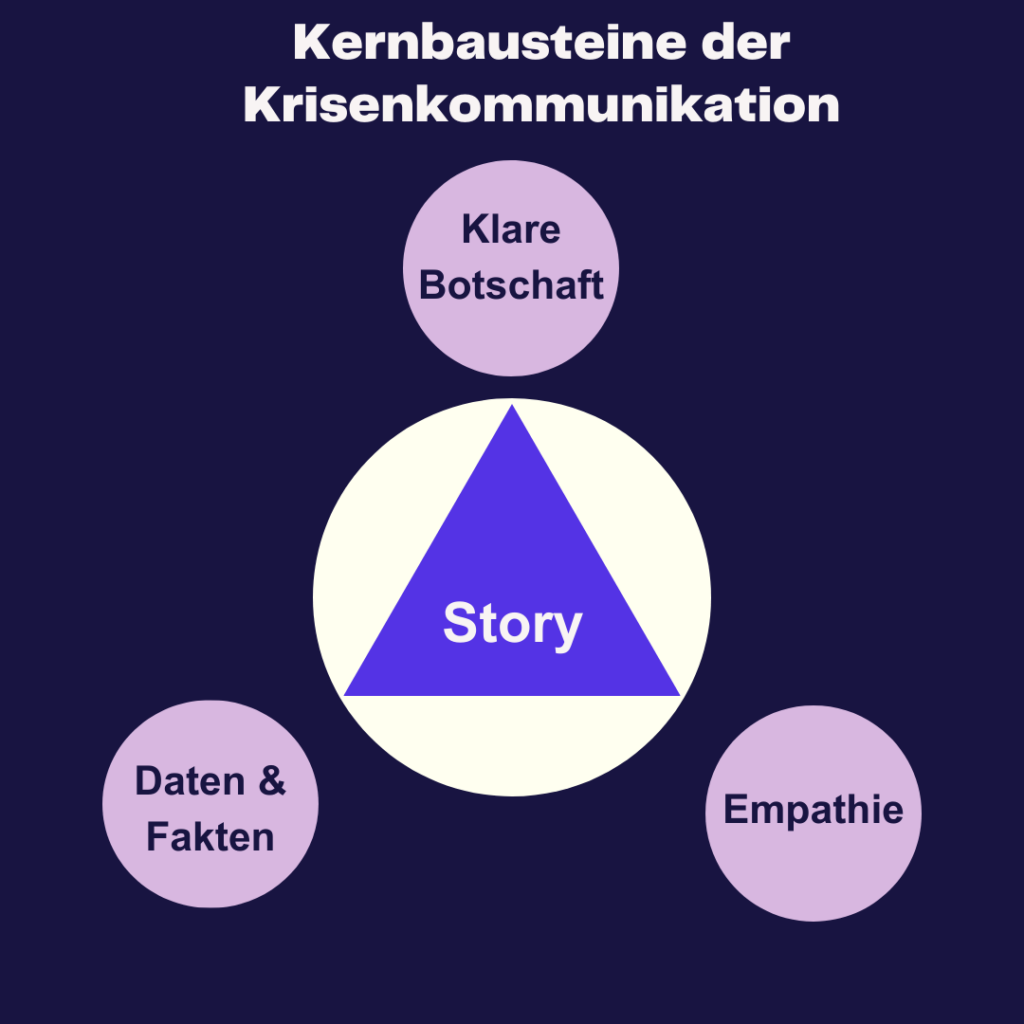
Storytelling enables open and honest communication that builds trust and maintains credibility. This is particularly important in times of crisis. However, companies should practice storytelling at all times so that they don’t have to start looking for data or protagonists when a critical situation arises. Prepared wording for possible scenarios also saves valuable time if the worst comes to the worst.
“Unternehmen verzichten beim Storytelling in der Krise besser darauf, sich als Held:innen ihrer eigenen Geschichte zu inszenieren. Vielmehr geht es darum, die Geschichte der Betroffenen – beispielsweise von verärgerten Kund:innen – zu erzählen, denen das Unternehmen zur Seite stehen konnte.”, sagt Alexandra Reinig, Expertin für Storytelling in der Krisenkommunikation
Which channel to use for crisis communication: First internally, then externally
Crises are not just there. There is someone who calls them out. This role often falls to media representatives. It is in the interest of every organization that people talk to them and not about them. Even before this, it is important to hold discussions with relevant stakeholders, i.e. people who talk about the company and evaluate it. If these relationships have already been established with relevant media representatives, effective public relations work can be ensured.
! An important rule is to communicate first to those affected before information is released to the general public. If you are forced to make redundancies, for example, it is better to start by contacting your employees via your own channels before sending out a press release.
Conclusion: After the crisis is before the crisis
One aspect of seriousness is the openness of results. This means that not everything that is a crisis has to end dramatically badly, but can always be an occasion for social change that opens up new opportunities. However, in the event that an organization does not emerge stronger (in every respect) from critical situations, it can be followed up and learn from the experience. As Mashup Communications, we are following this path with the aim of acting more resiliently.
! To this end, “lessons learned” should be identified and incorporated into the communication plan for crises in the future. Feedback from the target groups, which can be collected and evaluated both internally and externally, is particularly valuable. This makes it possible to better prepare for (renewed) crises in order to be able to communicate immediately with clear messages and in the right place. Because one thing is certain: the next communication challenge is sure to come.
FAQ: Crisis Communication & Resilience
1. What is crisis communication?
Crisis communication refers to a company’s strategic communication during exceptional situations. The goal is to maintain trust and minimize damage to its reputation.
2. Why is resilience important for businesses?
Resilience enables organizations to respond flexibly to crises, remain capable of taking action, and emerge stronger as a result.
3. What should a crisis communication plan include?
Clear responsibilities, defined communication channels, and prepared key messages for potential scenarios.
4. How should a company respond in an emergency?
Fast, transparent, and fact-based. Providing initial information early on helps prevent rumors and a loss of control.
5. What role does storytelling play during a crisis?
Storytelling combines clear messages, facts, and empathy. It makes complex situations easier to understand and builds credibility.
6. What should be done after a crisis?
Analyze the crisis, document the lessons learned, and optimize the communication plan. This is how resilience is built over the long term.

Alexandra Reinig ist Expertin für PR und Data Storytelling mit einem soziologisch-journalistischem Hintergrund. Ob Unternehmenskommunikation, Markenstory oder Kampagne – Alexandra sucht stets nach neuen Ideen und Wegen, um Botschaften klar, emotional und wirkungsvoll zu vermitteln.
Share this article
Related articles


10 November 2026
Strong Employers, Weak Stories: The Employer Branding Problem Facing Global Market Leaders
Read More