
The Power of Bricks: Storytelling with LEGO
I’ll admit it: as a kid, I was a Playmobil and Barbie girl. To me, LEGO was just something my brothers used to annoy me with when they’d rummage through their boxes for hours on end.
Thanks to my son, I had to take a closer look at LEGO and learn how individual bricks can be turned into impressive structures. To this day, I’m proud of the Ninjago helicopter, which took me an entire Sunday to build. But it still didn’t become my favorite hobby.
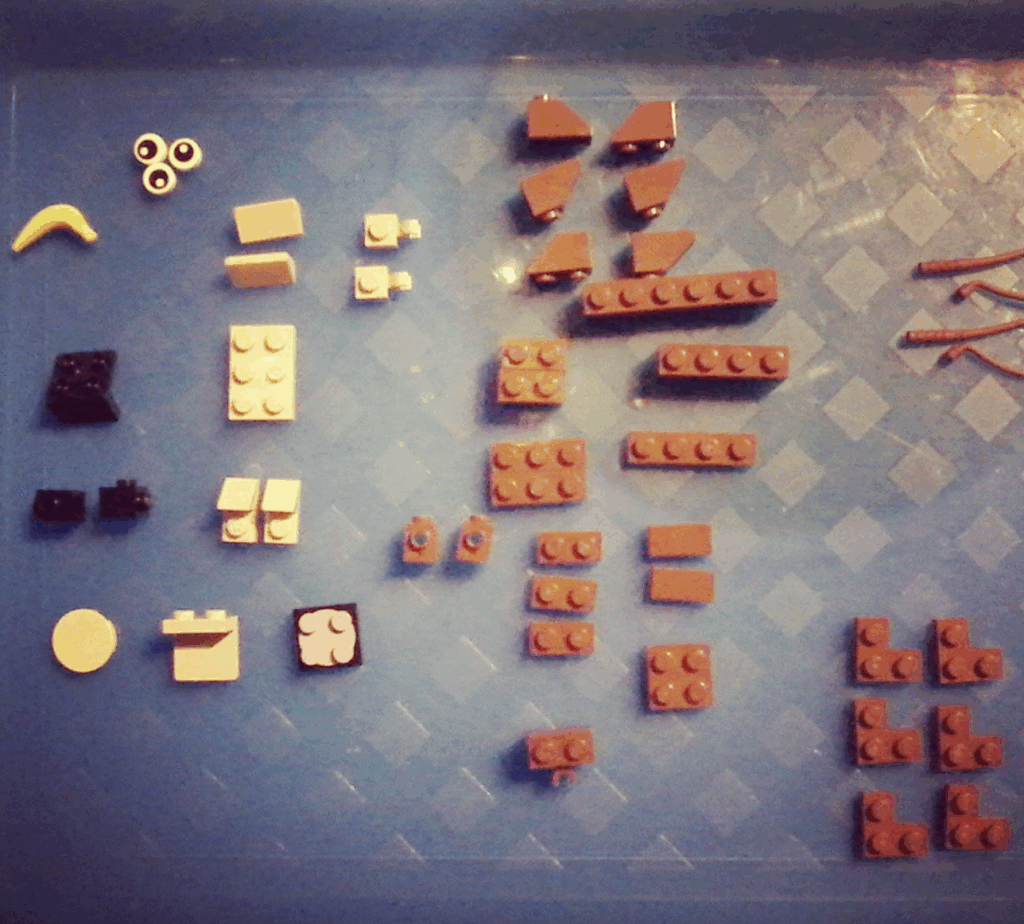
LEGO bricks as a strategic tool
It was different when I attended a Barcamp in Leipzig a few years ago and took part in a session on LEGO® SERIOUS PLAY®. Suddenly, I realized just how powerful those little bricks can be as a communication tool.
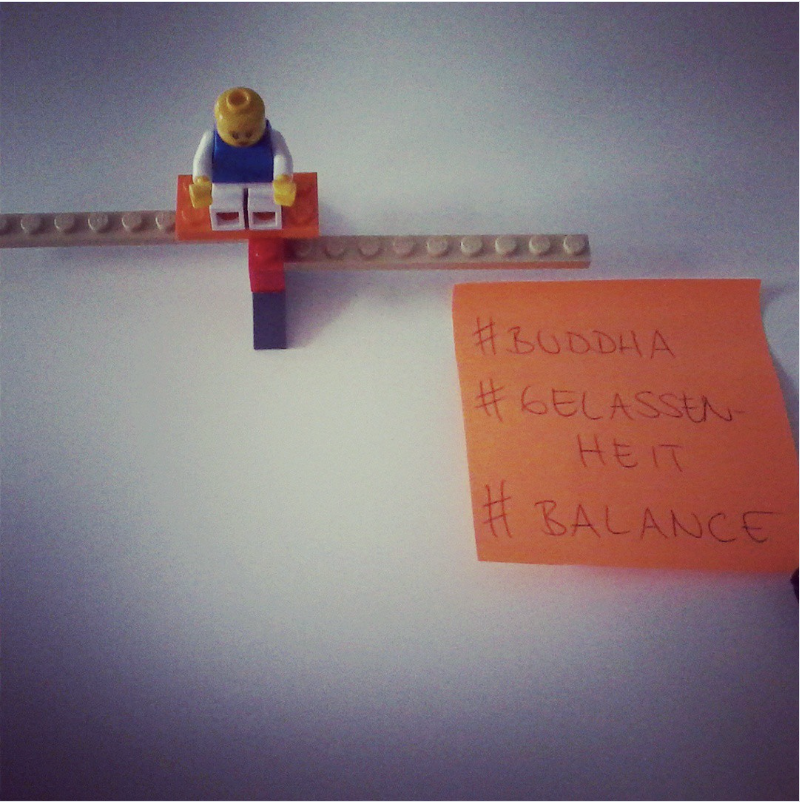
The idea had been floating around in my head for a while, but it never really took shape. That is, until I came across it again at a networking event and decided: I absolutely want to complete the LEGO® SERIOUS PLAY® facilitator training. I found exactly what I was looking for at Hello Agile and had the opportunity to experience two informative and inspiring days. Of course, I don’t want to keep the knowledge I’ve gained from you.
Who invented LEGO® SERIOUS PLAY®?
LEGO® SERIOUS PLAY® (LSP) was developed in the late 1990s by Professors Johan Roos and Bart Victor. It originated from an initiative by Kjeld Kirk Kristiansen, then owner of the LEGO Group. He wondered why, in strategy workshops, only a few people often actively contribute their ideas, while the knowledge and experience of many others go untapped.
Working together with researchers and experts in the fields of management, organizational development, psychology, and learning, they developed a method that took a completely new approach: rather than simply discussing ideas, people were encouraged to use LEGO bricks to visualize their thoughts, ideas, and perspectives. The goal was to stimulate the creativity of everyone involved and to better harness a group’s “collective intelligence.”
What initially sounded unusual quickly evolved into a method used worldwide for strategy development, team building, innovation processes, and conflict resolution.
The Language of Stones: The Inner and Outer Worlds
But what do colorful LEGO bricks actually have to do with strategy, communication, or organizational development?
In everyday life, many of our thoughts revolve around what is known as our “inner world”: experiences, beliefs, fears, desires, or unspoken assumptions. These thoughts are often difficult to put into words and even harder for others to understand.
In LEGO® SERIOUS PLAY®, these inner images are translated into the outside world. Abstract thoughts are transformed into tangible models that serve as metaphors for ideas, challenges, or relationships. For example, a tower can represent stability, a bridge can symbolize cooperation, and a wall can represent an obstacle.
The model thus becomes a common language. Instead of discussing abstract concepts, participants talk about something that is right there in front of them. This not only makes it easier to understand, but also creates space for perspectives that often go unheard in traditional meetings.
Why does LEGO® SERIOUS PLAY® work?
1. The Hand-Brain Principle
A key component of the method is the so-called hand-brain principle. When we build, different thought processes are activated than when we are simply speaking or writing. The hands are directly connected to various areas of the brain and support creative and associative thinking.
Anyone who has ever suddenly had a good idea while out for a walk or drawing is familiar with this effect: movement and active creation foster new perspectives. LSP takes advantage of precisely this mechanism.
2. Radical Simplification
Complex topics can often seem overwhelming. A LEGO model forces us to narrow our focus to what really matters. Which elements are truly important? How do they relate to one another? What story does the model tell?
This simplification makes even complex issues easier to understand and discuss.
3. LEGO as a Medium
The stones themselves are much more than just toys. They serve as a neutral medium between people and their ideas. Criticism is not directed at a specific person, but rather at a model or an interpretation. This often leads to more open conversations and more constructive discussions.
At the same time, building helps lower the barrier to voicing unusual thoughts. A metaphor laid out on the table is often easier to share than a half-baked idea in a traditional discussion.
What is LEGO® SERIOUS PLAY®?
LSP is a facilitated method used to visualize concepts, experiences, and ideas in real time—first individually, and later as a team.
In other words:
“LSP creates a common language. The LEGO models serve as visual anchors: from grasping to understanding.”
Definition of LSP provider Hello Agile
This fosters conversations on a different level: abstract ideas become tangible, complex relationships become clear, and different perspectives become understandable to everyone.
How does LEGO® SERIOUS PLAY® work?
Before the actual work begins, participants first learn the basics of the method. It doesn’t matter whether someone is an avid LEGO fan or—like I was at first—someone who isn’t really into LEGO at all.
The first exercises serve as a warm-up and demonstrate how metaphors can be expressed through simple models. It quickly becomes clear that the goal is not to create something particularly beautiful or technically perfect. What matters is the meaning behind the model.
“For many people, it’s during the storytelling phase that the true magic of the LEGO Method becomes apparent: a few bricks give rise to stories, ideas, and insights that would often have remained hidden without the model.”
Nora Feist, storytelling expert and LEGO® SERIOUS PLAY® facilitator at Mashup Communications
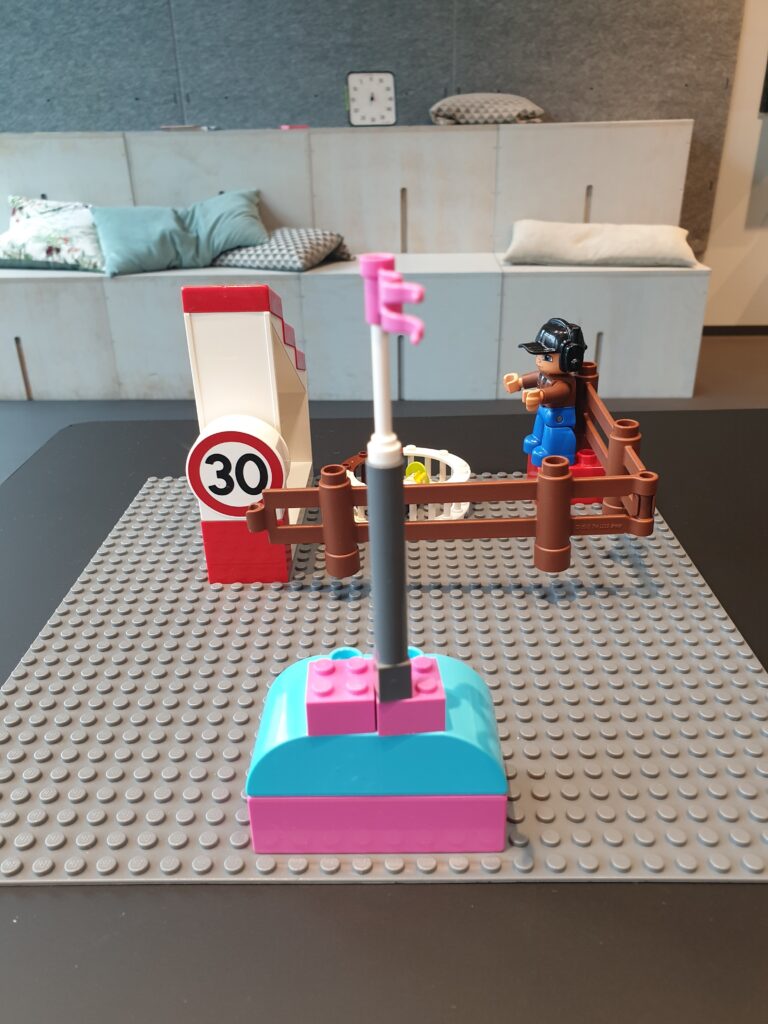
From Skill Building to the Construction Process
After the initial exercises, we move on to the actual construction phases. Depending on the problem at hand, we first create individual models, then group models, and finally complex system models that reveal interrelationships and interactions.
LEGO® SERIOUS PLAY® always follows the same cycle:
Build → Share → Reflect
Sharing is a central part of this process. Each person explains their model and is given a chance to speak. This brings different perspectives to the table that might otherwise have remained hidden. Only on this basis can the group reflect together, identify patterns, and develop new approaches to solving problems.
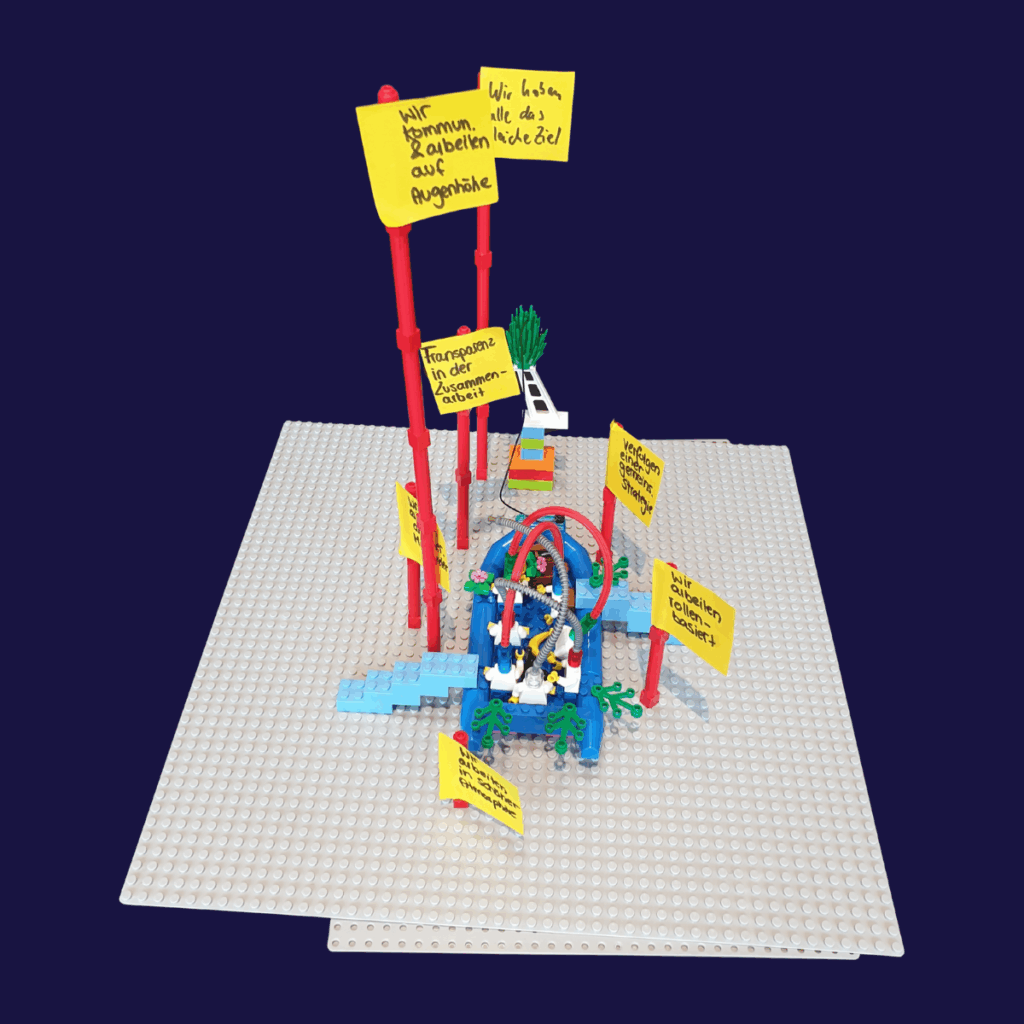
For me, that is precisely where the method’s particular strength lies: it combines creativity with structure and makes even complex topics accessible. Whether it’s strategy, teamwork, change processes, or personal issues—basically, almost any topic can be addressed using LSP.
And sometimes this leads to insights that you probably would never have arrived at using traditional workshop methods.
In any case, I’m already itching to get started, and I can’t wait to host an LSP Day with our team—and maybe even as part of a client workshop in the future.
FAQ: LEGO® SERIOUS PLAY®
What is LEGO® SERIOUS PLAY® (LSP)?
A workshop method in which ideas and thoughts are brought to life using LEGO bricks.
What is the LSP method suitable for?
LSP is suitable for strategy, team development, innovation, or solving complex challenges.
Why does LEGO® SERIOUS PLAY® work?
Because building fosters creative thinking and makes abstract concepts tangible.
How does an LSP workshop work?
After a brief warm-up, the same cycle always follows: Build → Share → Reflect.
More articles about workshops:

Nora Feist ist Storytelling-Enthusiastin, PR-Expertin und gemeinsam mit Miriam Schwellnus Geschäftsführerin von Mashup Communications. Seit 2010 begleitet sie Unternehmen dabei, ihre Geschichten zu entdecken und zu erzählen. In Workshops, Webinaren und Online-Kursen gibt sie gern ihr Wissen rund um Storytelling und Employer Branding weiter.
Share this article
Related articles

27 August 2026